
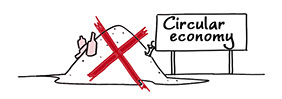
By 2050, around 70% of the world's population will live in megacities, mainly in delta and coastal areas. Large urbanised regions will have to transition to a circular economy and sustainable water and energy sources with the aid of digital developments such as precision agriculture and city farming. This will lead to resources being recycled and waste production being reduced to a minimum. The circular economy will contribute to overall prosperity through economic growth and a reduced pressure on the environment and resources. This requires circular, optimally engineered processes and concomitant changes to society with the aid of digital and other developments.
A researcher introduces herself:
Circular economy
I study general ways to handle complex interconnected systems in an information rich environment. We develop algorithms for complexity reduction, and for interconnecting systems efficiently. We recently started a collaboration with economists and environmental psychologists in order to develop the technology such that it is acceptable in society and embedded in our economy.
Our research field is systems and control, the hidden technology ubiquitous in devices we use in our everyday life, varying from home appliances to health care and industrial devices. Nowadays, this technology is implemented in the form of algorithms on digital computers (micro-controllers) inside the devices. A recent challenge is that the algorithms need to be adapted to devices that function in our more and more interconnected, and technologically more complex world, using information from the large amounts of measurements. We study ways to reach an overall goal while only having communication between neighboring devices, such as between neighboring mobile robots in an industrial environment, or neighboring households who share energy that is locally produced by for example solar panels. In the case of the mobile robots the overall goal may be to have a very efficient way to handle the inventory of a factory, and in the case of the households in an energy grid the overall goal may be to minimize the energy imbalance. Different goals can be set, but the crucial part is that the (digital) control methods are able to reach this central goal
 autonomously by only sharing information with neighboring devices. Naturally, the limitations of the communication technology need to be taken into account. It is highly relevant for application fields such as Smart Industry, and Smart Energy Systems, where central communication is not feasible, or simply not practical.

