
Security
The application of digital technology will increase security, but it will also create risks and engender feelings of insecurity. Security will increase thanks to the use of cameras, robots, biometric sensors, email monitoring and other types of screening. The risks and feelings of insecurity will arise from events such as data/identity theft or accidents involving driverless cars. Better protection of digital information is essential, with faster computers requiring encryption methods that are both secure and realistic. Digitisation also presents major challenges to our physical and national security. Conflicts will more often be fought with robots, drones and digital attacks on energy supply, water management and payment networks. Such networks must be prepared to defend themselves against these threats.
Researchers introduce themselves:
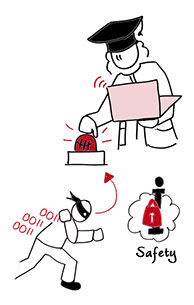
I work in the Cyber safety Research Group (CRG). That is a partnership between NHL University of Applied Sciences and the Dutch Police Academy. Having its roots in social sciences (e.g. criminology, sociology, law) the CRG is actively involved in the multidisciplinary Cyber Science Centre in which scholars with a wide variety of backgrounds work together on questions of digitisation and safety/security. The CRG's research program 2015-2020 is entitled 'Safety, Security and Law Enforcement in a Digital Society'.
The research program consists of three different but equally important issues: (a) business and cyber security, (b) youth and cyber safety, (c) policing a digital society.
Law enforcement in the wide sense of the word is the connecting theme. Within the three main issues attention is given to offenders, victims as well as the effectiveness of measures. The issue 'policing a digital society' refers to (i) the police acting against cybercrime and cyber enabled crime as well as (ii) the police using digital technologies for the purpose of law enforcement. Some examples of actual CRG research are: Youth with a Mild Intellectual Disability and Cybersafety; Mental Factors Determining the Use of Digital Forensic Evidence; Police Detectives on the TOR Network; Public Private Partnerships in Fighting Internet Banking Fraud; Security of Online Banking From an End-User Perspective; Cooperation Between Youth and Police in Online Detective Work ('Teenage Crime Fighters on the Internet').

Over the last decade we worked on a number of scientifically and societally relevant security topics such as chipcards in passports and public transport, electronic voting, smart metering, road pricing and privacy. I am a member of the Academia Europaea and a recipient of an ERC Advanced Investigator Grant (2012) on quantum computation, logic, and security. I am also a member of the National Cyber Security Council and I head the advisory board of the digital rights organisation Bits of Freedom. I am regularly asked as an expert in the media and in Parliament. My opinion is that digitisation of our society has a strong political character. However, the public interests are often neglected and power is carelessly handed over to 'big-IT', that is controlling the main data flows. These changes will disrupt society as we know it. Our society is built on the idea of autonomous individuals, but now they can be steered commercially and politically via information selection and personalised services.

