
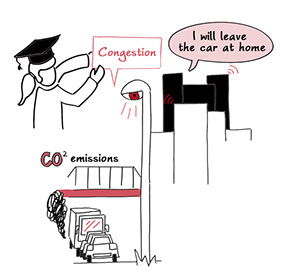
Well-integrated technology can help meet the demand for mobility, resulting in fewer traffic jams, less air pollution, less energy consumption and fewer road accidents. 'Smart cities' should be able to grow while maintaining quality of life and a healthy environment by listening and responding to the information generated by citizens and their behaviour. An efficient and reliable transport system is vital in this respect. Online shopping and demographic developments are increasing mobility and transport flows, which will have to be streamlined through the use of new digital technologies, coordinated with personal needs.
Researchers introduce themselves:
Mobility
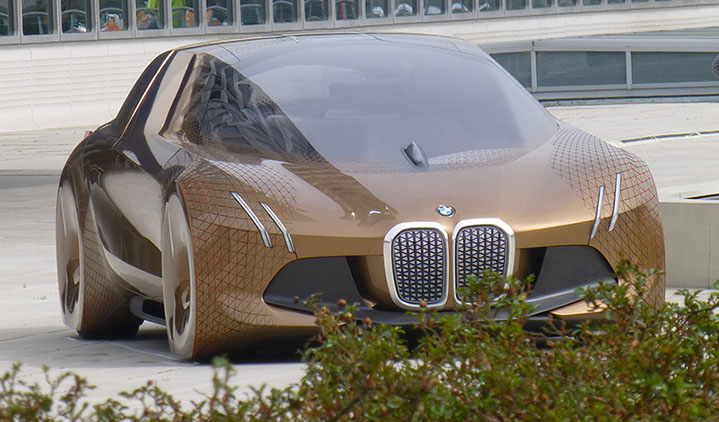
In the future we will increasingly be surrounded by intelligent technology; both inside our homes as outside on the street, in visible as well as invisible ways. Cars will evolve into iPads on wheels and all kinds of robots will help do our job and take care for the ill and elderly. Living with a private robot will be as common as keeping a pet. Every day the interaction between humans and technology will increase. It will change society and this revolution offers opportunities for solving social problems. For the high tech industries it means that technological changes will speed up, connectivity of machines will enable new services, and processing of smart materials will enlarge the design space. The systems thinking, integration and multi-disciplinary aspects will become key enablers for innovation. The automotive sector will change in the next decade more than in the past 100 years.
Creating practical geo-information for individuals and society - that would be an apt brief description of our research. We have three research themes. The first theme deals with geo-information infrastructures that form the backbone for the digital geo-society. We study the assessment methods for these infrastructures, as well as effective and efficient governance approaches.
The second theme relates to acquiring geo-information. We are experimenting with drones and citizen-sourced information. We use the geo-information collected by citizens, also referred to as informal geo-information, to examine how we can establish the quality of information and how to best integrate the informal information with formal information sources.
In the third theme we study the behaviour of people in their environment. This is done experimentally and with models. An example is using geo-information technology to track the movement of individuals or groups of people through a space. In the modelling approach, we develop agent-based models that simulate the behaviour of people. This allows us to study the effect on the behaviour of various spatial designs.
Ons onderzoek op het Institute for Photonic Integration aan TU Eindhoven is gericht op het verschaffen van de infrastructuur voor de toekomst van de digitale samenleving. Mijn groep, Electro-Optical Communication Systems, maakt systemen die communicatie mogelijk maken, overal, altijd, met een zeer laag energieverbruik, hoge snelheden en zonder overbelasting. Dit zijn systemen met glasvezel, draadloze optische stralen en radiogolven die via glasvezel worden overgebracht.
Een hoogtepunt van ons onderzoek is een gerealiseerde dataoverdracht van 255 terabits per seconde door een enkele multicore glasvezel van een kilometer lang met een dikte van slechts twee menselijke haren. Dat is ruim voldoende om ongecomprimeerde telefoongesprekken (64 kbit/s) tussen de ene helft van de wereldbevolking en de andere helft mogelijk te maken. Ook hebben we een nieuwe platte netwerkarchitectuur voor datacentra ontwikkeld met volledig optische routing van datastromen waarbij slechts weinig latentie optreedt, met gebruik van fotonische geïntegreerde circuits met meerdere golflengtes. Daarnaast hebben we een draadloze overdracht van 42,8 gigabits per seconde in een vertrek bereikt door middel van een bestuurbare straal van infraroodlicht. We hebben deze techniek ontwikkeld om vanaf één aan het plafond bevestigd passief apparaat een willekeurig aantal van dergelijke stralen te sturen naar afzonderlijke apparaten in het vertrek.
Deze technieken worden gebouwd op basis van de unieke technologie van generieke fotonische integratie die op ons instituut is ontwikkeld en in de cleanroom is uitgevoerd. Dankzij deze technologie kunnen we nieuwe fotonische circuits in indiumfosfide produceren in een snel en eenvoudig toegankelijk multi-project wafer-proces.

