
Digitisation can help healthy people to give up unhealthy habits and live a healthier lifestyle. With the aid of smart technology, senior citizens can live independently for longer. Analysis of digital data can help to diagnose illnesses earlier and identify outbreaks of contagious diseases at an earlier stage. Intelligent or humanoid robots can both activate patients and keep them company.
Researchers introduce themselves:
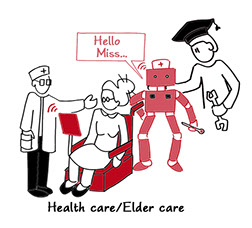
Health care
Healthcare is increasingly characterized by digital eHealth applications such as apps, serious games, or e-coaching, for both the prevention and treatment of somatic and mental conditions. For example, chronic somatic conditions can not only result in physical complaints such as pain, itch, and fatigue, but also in problems of negative mood, limitations in daily activities and impairments in social relationships. These patients can benefit from online screening and tailored self-management treatments. eHealth is also an important instrument to empower patients and can contribute to shared decision-making. Moreover, digital solutions are increasingly used for the prevention of chronic somatic and mental conditions, such as heart diseases and depression.
Tailored to individual needs
 The main aim of the eHealth and self-management research programme is to optimize health care for a wide variety of patient groups by developing, evaluating, and implementing online screening instruments and self-management interventions that can be tailored to individual needs. The research programme encompasses a broad variety of projects developing and testing the effectiveness of digital screening instruments to select subjects at risk and offer them tailored interventions (e.g. online self-management interventions for patients at risk for adjustments problems to a chronic condition) using various applications (e.g. apps, games, e-coaching, virtual reality).
e-Coach
The e-Coach for patients with chronic somatic conditions, for example, is an online self-management intervention guided by a therapist who gives online individualized feedback on treatment goals and assignments. Treatment goal is to reduce the impact of the chronic somatic conditions on the patients' daily life. The e-Coach offers tailored treatment modules corresponding with the specific risk profiles of individual patients. Themes of these modules include physical, psychological, and social adjustment, such as pain, fatigue, mood problems, and social relationships. Each module includes multiple assignments and reading texts that are tailored to the specific patient's goals. The (cost)effectiveness of this and comparable programs have been demonstrated in various patient groups and the programme is currently broadly implemented in healthcare.
The research programme eHealth and self-management is embedded in the Faculty of Social and Behavioural Science of Leiden University together with the Leiden University Medical Center, the related university profile areas of both faculties Health across the Human Life Cycle as well as the Medical Delta network in collaboration with TU Delft and ErasmusMC as well as private partners.
I am a neuroscientist who studies the brain processes enabling us to form and stabilize memories using diverse methods including experimental psychology, functional neuroimaging, genetics, pharmacology, and endocrinology. Our ability to form new memories is shaped not only by stable differences between individuals or by disease like dementia, but also by the current state we are in. For instance, stressful live-events are particularly well remembered so that we cannot forget them anymore leading in some vulnerable individuals to traumatic, intrusive memories underlying psychopathology. But also the way how we encounter new information that is associated with already existing knowledge shapes learning and stabilization of new memories. This interaction between existing and new memories is particularly important for (formal) education and appears dynamically modulated throughout brain development.
 VToday, we are tapping into seemingly unlimited, digitized information serving as extracorporeal memory, which appears to have profound influences on our memory and the way we learn. However, we do not know the consequences of our digital life in detail yet and we do not have a mechanistic account for them either. This understanding is though essential for optimal interfaces, for recommendations on how to combine digital and neural memory. Potentially more importantly, if we understand the neurobiological effects of our digital life, we might be able to develop new approaches for education and treatment of mental illnesses.
The National Science Agenda and the Horizon2020 program indicate that promoting health and well-being is a grand challenge for society. Health can be defined as 'the ability to adapt and to self-manage, in the face of social, physical and emotional challenges' (Huber M et al., BMJ 2011). Health-promoting behaviors constitute
 one of the foundations of adaptation and, hence, of good physical and mental health. However, health and well-being are not distributed randomly throughout society, and psychosocial factors such as education, gender or personality are major determinants of individual differences in health. Moreover, advances in biomedical science have also resulted in people living longer with chronic diseases, leading to a prominent role of patient-centered outcomes such as quality of life and perceived health in health care.
Recent developments in the digital society provide ample opportunities to improve health and well-being both at the individual and societal level. New approaches in data science and treatment strategies (eHealth interventions, remote patient monitoring) will advance more personalized care for individuals with chronic somatic or psychological problems. For example, the large population-based PROFILES registry uses new information technologies to investigate and enhance patient-centered outcomes in the treatment of cancer. In the emerging field of apps and wearable technologies, experience sampling will generate much information on physical activity, sleep, food intake and emotions. Analysis of these data will lead to a more effective, personalized approach to behavior change in health and well-being. New digital tools are also being developed to explore systematic differences in healthcare, and to provide both professionals and health organizations with relevant information that helps them to improve care.

