
Education
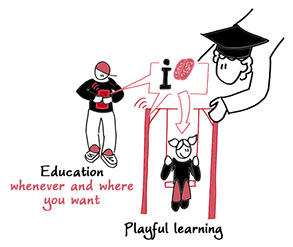 Digitisation will drastically change both the structure and content of education. Technology creates opportunities to better align education with individual learning needs and styles. The role of teachers and lecturers will change, for example because students can access online information and lectures from anywhere and at any time, giving them permanent access to high-quality education. Digitisation will also create a demand for new, data-related expertise, which will need to be developed. Educational research will focus on the fundamental position of education in a world in which circumstances and requirements are changing rapidly and radically, and in which people are permanently part of data networks. Attention will be paid to the psychological and social consequences of this, in particular for children, adolescents and people who are unwilling or unable to keep pace.
A researcher introduces himself:
Neurocognition aims to understand the causal mechanisms underlying human behavior. One important topic is how the brain learns from the past to predict the future in an optimal manner. Learning mechanisms have been studied from the micro-cellular level and below (atoms, genetics) till the system level (human brain and behavior) and beyond (population studies). In my research I concentrate on system-level mechanisms of learning in general with a specific focus on the mechanisms underlying language, communication and social interaction.
 Neurocognition in digital education
Recently, science and society became aware that the traditional one-size-fits-all approach in teaching is sub-optimal, as easily is the case in the current class-room setting. Curricula are often based on traditional text books boosting a single-learning-track procedure for all students. Now, a more personalized approach in digital education is possible supported by current information technology. These technologies are already widely used nowadays, but often limited to adapt to the knowledge level, rather than to the knowledge content of the student. Implementing neurocognitive theories and machine-learning techniques about human knowledge offers promising avenues to enrich learning processes in a truly personalized manner.

